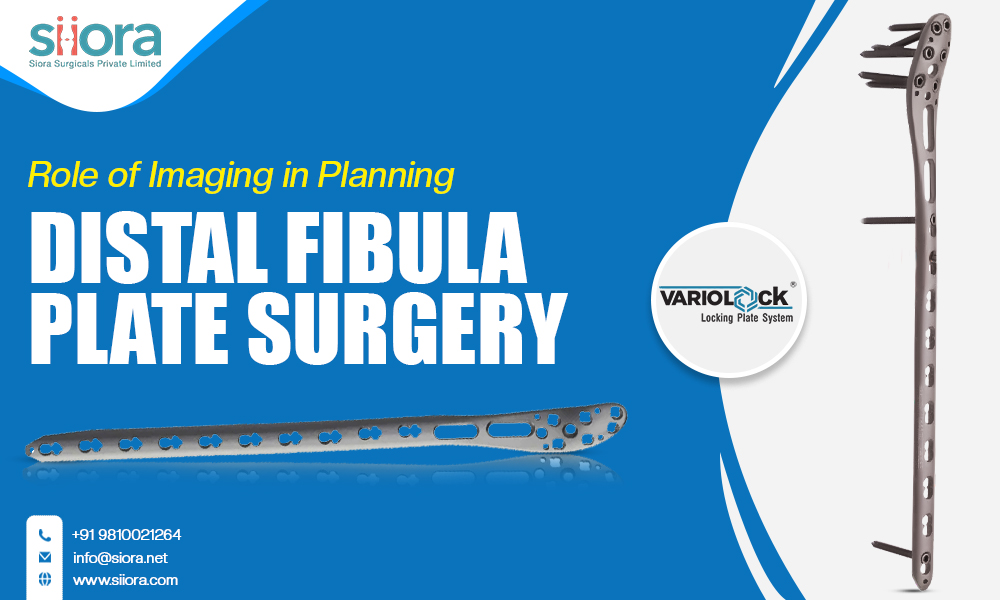
You take a nasty spill, your ankle balloons to the size of a tennis ball, and you find yourself in an exam room staring at a brightly lit screen. On it is the first image of your new reality: an X-ray of your broken ankle. Most people think the X-ray’s job is just to answer the simple question, “Is it broken?” But for a surgeon, that black and white image is the first page of a detailed battle plan. Modern imaging is our roadmap, our blueprint, and our GPS, guiding every decision we make to get your ankle fixed perfectly, either with a distal fibula plate or without it.
The Standard X-Ray: Getting the Lay of the Land
The first step is always a set of standard X-rays. We take at least three views: one from the front, one from the side, and a special angled view called a “mortise.” This isn’t just to see the crack. It is important to immediately try to figure out the “personality” of your fracture.
- Where is the break? Is it below, at, or above the key ligaments of the ankle (the syndesmosis)? This is the famous A, B, C classification that tells us about the stability of the entire joint.
- How is it broken? Is it a simple, clean two-piece break? Or is it shattered into multiple fragments (comminuted)? This helps us decide what kind of plate we might need—a simple compression plate or a more robust locking plate.
This initial X-ray gives us the lay of the land. It tells us the general strategy, but sometimes, for the really tough cases, we need to zoom in.
The CT Scan: The 3D Blueprint
What happens when the fracture line disappears into the ankle joint itself? An X-ray is just a flat, 2D shadow. It can hide the true complexity of a fracture that involves the joint surface. If that joint surface heals with even a millimeter-sized step in it, it’s a guaranteed recipe for painful, early-onset arthritis. We can’t afford to get that wrong.
This is when we call in the CT scanner. A CT scan is the difference between looking at a photograph of a house and having the full architectural blueprints. It gives us a high-definition, 3D picture of the fracture. We can see:
- The exact number and location of every little fragment.
- The precise amount of displacement or “gapping” in the joint.
- Any hidden fractures that the X-ray might have missed.
With this 3D blueprint, we can do our pre-operative planning. We can decide exactly where we’re going to make our incision, what kind of plate will fit best, and where each screw will need to go. We can essentially perform the surgery virtually before we even step into the operating room.
The C-Arm: Our Live-Action GPS in the OR
The planning doesn’t stop once you’re asleep. Throughout the surgery, we use a mobile X-ray machine called a fluoroscope or C-arm. This is our real-time GPS. It gives us instant X-ray images, allowing us to check our work at every critical step.
- Confirming the Reduction: Before we put the plate on, we use the C-arm to confirm that we have lined up the bone fragments perfectly.
- Checking Screw Length: After we drill for a screw, we use the C-arm to ensure we are using the perfect length—not too short to be weak, and not too long to irritate the tendons on the other side.
- Performing a Stress Test: After the fibula plate is on, we use the C-arm to perform a stress test, physically checking the stability of the syndesmosis to make sure we haven’t missed a hidden ligament injury.
The Bottom Line
From the initial X-ray map to the detailed CT blueprint to the live-action GPS in the operating room, imaging guides every single step of your surgery. This meticulous, multi-stage approach is what allows us to achieve the precision needed for a stable, long-lasting repair and give you the best possible shot at a full, pain-free recovery.
If you want to explore the latest advancements in medical technology, along with cutting-edge trauma implants, book your visit to WHX Dubai 2026.
 Siora Surgicals Pvt. Ltd.