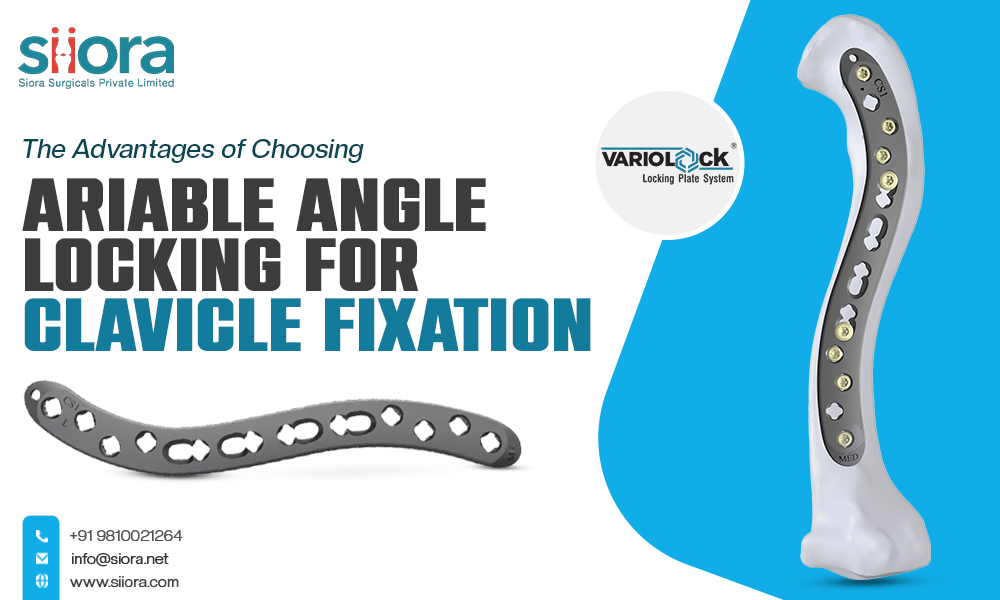
Clavicle fractures might look simple on an X-ray, but anyone who treats them regularly knows how unpredictable they can be. The clavicle is a small, curved bone that plays a big role in shoulder movement, posture, and upper-body strength. When it breaks, restoring its alignment isn’t just about healing bone—it’s about bringing back proper shoulder function. That’s where variable angle locking technology has quietly changed the game.
Traditional plates worked well in many cases, but they came with limitations. Every clavicle is shaped a little differently. Fracture patterns vary. Bone quality changes with age and injury severity. Variable angle clavicle locking plate systems offer a level of flexibility that fixed-angle plates simply can’t match.
Benefits of Variable Angle Locking Technology for Clavicle Fixation
Better Adaptation to Natural Anatomy
No two clavicles are identical. Some are flatter, some have sharper curves, and many don’t match the “standard” shape assumed by rigid implants. With fixed-angle plates, surgeons often have to compromise—either with screw direction or plate positioning.
Variable angle locking allows each screw to be inserted at a customized angle while still locking securely into the plate. This means the fixation adapts to the patient’s actual anatomy instead of forcing the bone to adapt to the implant. That subtle shift in philosophy plays a huge role in accurate fracture stabilization.
Stronger Hold in Weaker Bone
Not all clavicle fractures occur in young, athletic patients with dense bone. Many occur in elderly individuals, crash victims, or patients with poor bone quality. In those situations, screw purchase becomes a real concern.
Variable angle locking improves bone grip by allowing the surgeon to steer screws toward stronger areas of the bone. Instead of relying on a single fixed trajectory, the implant works with the surgeon to find the best hold. This leads to better resistance against loosening, especially during early shoulder movement.
More Control in Complex Fractures
Simple fractures are one thing. Multi-fragment injuries are another. Comminuted clavicle fractures often leave surgeons working with small bone pieces that don’t always behave nicely.
With variable angle locking, screws can be directed to capture fragments more precisely without interfering with neighboring screws. This makes it easier to stabilize multiple pieces solidly without overcrowding the plate or weakening fixation points.
For complex fracture patterns, that extra control makes a noticeable difference in both stability and confidence during surgery.
Reduced Risk of Screw Backout and Plate Failure
One of the long-term concerns with clavicle plating has always been mechanical failure—screws backing out, plates lifting, or irritation developing under the skin. Because variable angle systems lock each screw head firmly into the plate, they create a fixed-angle construct after final tightening.
Once locked, the screws and plate act as a single unit rather than separate components. This reduces micro-movement, lowers stress at individual screw points, and helps prevent gradual loosening over time.
Smoother Healing and Earlier Shoulder Movement
Stable fixation doesn’t just help bone heal—it helps patients move sooner. When surgeons trust the strength of their fixation, they’re more comfortable allowing earlier shoulder mobilization. That means less stiffness, faster return to activity, and improved long-term shoulder function.
With conventional plating, cautious rehabilitation is often necessary to protect the construct. Variable angle locking provides the confidence needed to balance protection with healthy movement.
Less Hardware-Related Discomfort
The clavicle sits just beneath the skin. Any bulky implant or poorly positioned hardware can become uncomfortable. Because variable angle locking allows better plate positioning and more precise screw direction, it often results in a lower implant profile.
Patients frequently report less irritation from clothing straps, bags, and sleeping positions compared to older plate systems. While implant removal is still sometimes required, improved plate design and positioning have helped reduce that need.
A Practical Advantage for Surgeons
From the operating room perspective, variable angle locking brings ease without sacrificing strength. It reduces the pressure of finding the “perfect” fixed screw path and allows surgeons to focus on fracture reduction and soft tissue handling.
The system works with real anatomy—not against it. That alignment between implant design and clinical reality is why many surgeons now prefer variable angle technology for clavicle fixation.
Why It Matters in the Bigger Picture?
Clavicle fractures impact posture, arm strength, and shoulder mechanics. When fixation fails or alignment is imperfect, the effects can linger long after the bone heals. Variable angle locking improves precision, stability, and adaptability—all three of which directly influence long-term outcomes.
It’s not just a technical upgrade. It’s a smarter way to match fixation to the patient rather than the other way around.
Final Thoughts
Choosing variable angle locking for clavicle fixation is about more than just flexibility—it’s about surgical accuracy, long-term stability, and patient comfort. By allowing controlled adjustment without compromising strength, this orthopaedic implant technology delivers results that feel more natural for both surgeons and patients.
In a region as delicate and exposed as the clavicle, that balance between adaptability and strength truly makes all the difference.
 Siora Surgicals Pvt. Ltd.